National Critical Minerals Heatmap
Color-coded national map of every documented mineral extraction site, ranked by predicted critical-minerals content per category. Filterable by state, era, primary commodity, claim status, and regulatory framework.
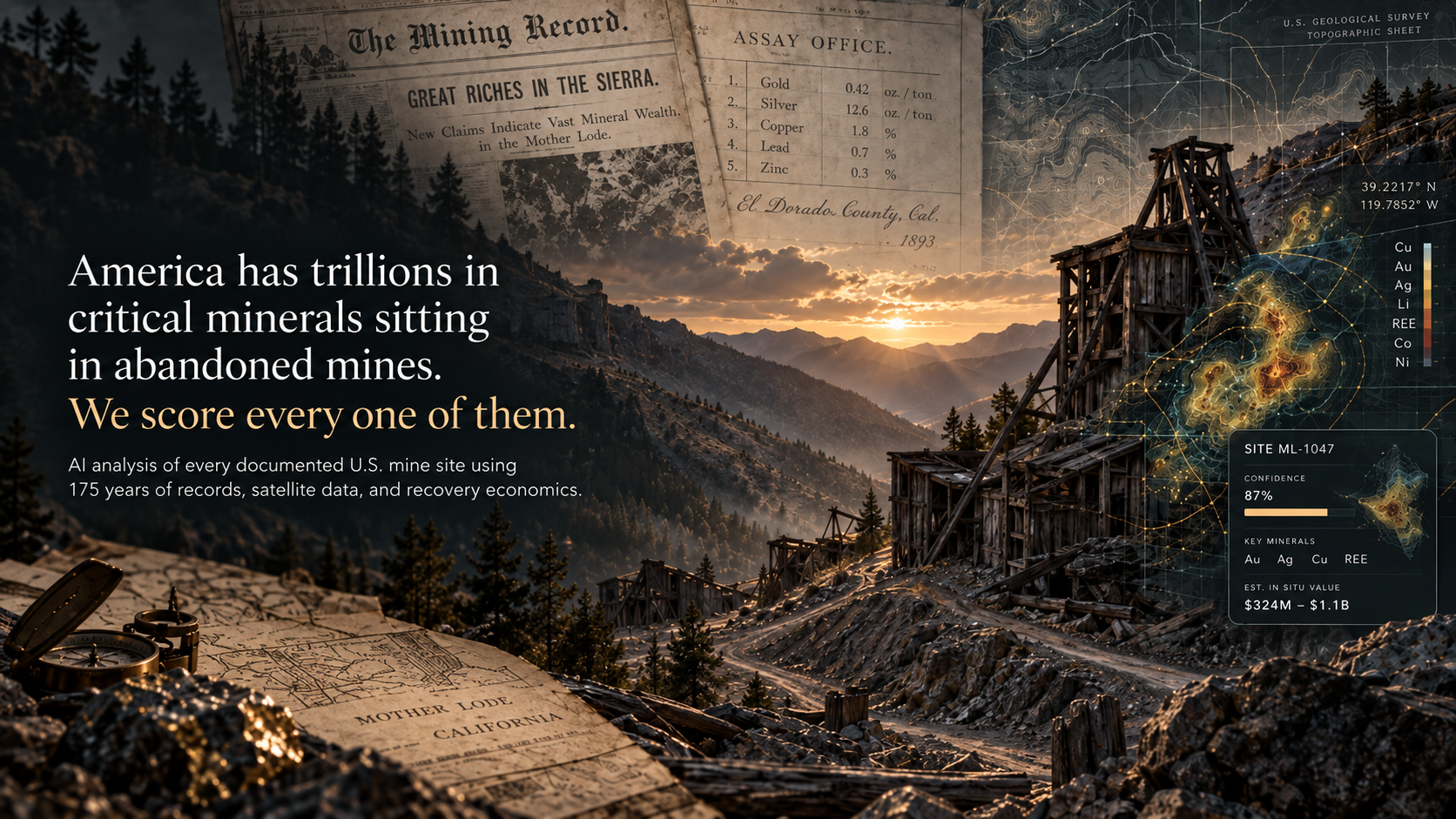
How MotherLode CMI turns 175 years of legacy mining records into an intelligence layer for critical minerals.
Historical mining operations from 1850 through the late twentieth century assayed only the primary commodity: gold, copper, silver, lead. Critical minerals such as rare earth elements, cobalt, lithium, gallium, germanium, antimony, and tellurium were typically discarded with the tailings or never measured at all. Modern surveys reach roughly five percent of the country. The data exists. It has never been integrated.
The platform combines AI-driven extraction of legacy mining records, multi-spectral satellite analysis, era-specific recovery efficiency modeling, and cross-site pattern matching to produce per-site bycatch predictions with confidence intervals, directly usable by program managers, state geological surveys, and operators.
Color-coded national map of every documented mineral extraction site, ranked by predicted critical-minerals content per category. Filterable by state, era, primary commodity, claim status, and regulatory framework.
Per-site predictive model with confidence intervals for rare earth elements, cobalt, lithium, nickel, gallium, germanium, antimony, tellurium, and other federally designated critical minerals.
One-click pre-formatted reports including site characterization, bycatch potential, reprocessing economics, ESG framework, regulatory pathway, and comparable-site case studies. Designed for direct submission alignment.
Single-pane view for program managers and state geological surveys. Tracks sites under evaluation, sites funded, sites in production, and outcomes per state. Cross-references domestic supply gap data to surface highest-priority opportunities.
Tight integration with separately patent-pending mercury and heavy-metal sequestration technology, enabling end-to-end remediation-and-recovery pathway design for sites with legacy contamination.
Geological signature matching identifies undiscovered analogs to historically productive clusters. Surfaces high-potential sites that are absent from existing databases. Patent pending.
U.S. critical-minerals policy is now actively funding the recovery of rare earth elements and other federally designated critical minerals from unconventional feedstocks including mine tailings, red mud, industrial scrap, and other waste streams the legacy assay record never measured.
MotherLode CMI is the upstream intelligence layer for that build-out. Per-site predictions with confidence intervals, sourced from an integrated corpus the federally funded cohort cannot assemble on its own, defensible under DOE and DOD program-manager scrutiny.
Inquiries from federal program managers and demonstration-facility awardees: please reach out directly.
Every documented mineral extraction site, every state, every era from 1850 forward.
REE, cobalt, lithium, gallium, germanium, antimony, tellurium, nickel.
From 19th-century stamp milling through modern flotation and leach circuits.
Live walkthroughs available on the demo. Production coverage scales nationwide.
Below is the actual MotherLode CMI output for a single representative site from the live demo dataset. Every line is generated from the integrated corpus described above, with confidence bands carried through to the predicted values.
The AI is the activation layer on top of the integrated data corpus. Each layer is patent-anchored, audit-trail-complete, and bound to a published methodology so partners can verify every prediction back to its source records.
Purpose-trained language models read century-old assay reports, drill logs, and state geological survey notes; convert unstructured text and tables into normalized assay records with per-field confidence scores.
A geological-signature embedding model places each documented site in a high-dimensional feature space. Cross-cluster analogs surface in seconds; novel-site discovery falls out of the same index.
A patent-anchored AI agent combines extracted assay data, cross-site signatures, era-specific recovery efficiency models, and modern multi-spectral signals into per-site predictions with confidence intervals.
Every prediction traces back to its source records. The agent is methodology-bound and cannot cite sources it does not have. No hallucination, no drift, no black-box outputs that program managers cannot defend.
The AI is the sizzle. The integrated data corpus and patent-anchored methodology are the steak. Both are required; neither is sufficient on its own.
Predictive intelligence per site in hours instead of months. Confidence intervals tighten as field outcomes feed back into the model.
Where modern surveys reach roughly five percent of the country, MotherLode CMI's historical-record integration covers the entire mining-active United States.
Multi-modal integration of historical assay records, geological signatures, era-specific recovery modeling, and modern satellite data. None of which exists in a single system today.
US Patent Application 19/680,696. All 20 claims allowed on first action, August 2026. The scoring methodology, data flywheel, compound AI valuation engine, and cross-cluster discovery mechanism are all covered. No competitor can legally replicate the approach.
The system improves with every site evaluated. Partners benefit from a tool that becomes more accurate the more it is deployed across the network.
The well-funded AI mineral platforms are all chasing new deposits in unexplored ground. KoBold Metals raised $280M and is backed by Andreessen Horowitz and Breakthrough Energy. Terra AI raised $24M from Khosla Ventures and BHP. VerAI is backed by Insight Partners. All three find new deposits. None of them touch the 300,000 documented US mine sites that already have 175 years of records. That is the gap MotherLode CMI fills, and no direct competitor operates in that space.
| Feature | MotherLode CMI | KoBold Metals | Terra AI | VerAI | USGS MRDS |
|---|---|---|---|---|---|
| Target asset | Legacy and abandoned US mine sites | Undiscovered greenfield deposits | Undiscovered greenfield deposits | Concealed subsurface deposits | Raw public records, unscored |
| Critical minerals bycatch scoring | Yes, 50-plus minerals per site | No | No | No | No |
| Patent-protected methodology | Yes, US 19/680,696 all 20 claims allowed | No | No | No | N/A |
| Certified output (AxioSurface) | Yes | No | No | No | No |
| No new drilling required | Yes | No | No | No | N/A |
| Speed per site | Hours | Months to years | Months to years | Months to years | N/A |
| Data flywheel | Yes, outcomes compound the model | No | No | No | No |
| Capital markets connection | Yes, via tokenization partner (revealed soon) | No | No | No | No |
Sources: KoBold Metals funding via Tracxn and Crunchbase. Terra AI Series B per Sacra Research. VerAI per Insight Partners portfolio disclosures. USGS MRDS is a public federal database with approximately 300,000 records and no AI scoring layer.
Every operator who deploys MotherLode CMI on a site generates ground-truth data: actual assay results, observed recovery efficiencies, encountered contamination, real-world economics. Verified field outcomes feed back into the model, tightening confidence intervals per category, refining era-specific recovery functions, and improving cross-cluster signature matching.
Operators contribute confirmed assay results, recovery efficiency, contamination encountered, and post-extraction economics through a verified-contributor framework.
Confidence intervals narrow. Recovery functions per era and per geological context recalibrate. Cross-cluster signature matching becomes more discriminating.
The next operator evaluating a comparable site receives sharper predictions, better economics, and a stronger grant-ready report than the operator before them.
This is the data nobody else has. Federal databases hold the historical records. Modern surveys hold the contemporary geology. Operators hold the ground-truth. MotherLode CMI is the first system to integrate all three with a feedback loop that compounds across deployments.
The platform extracts geological, geochemical, and structural signatures from historically productive mining clusters. It then scans the broader mining-active landscape for areas that share those signatures but were never developed, never recorded, or never assayed for critical minerals.
The result is a new class of opportunity: high-potential sites that are absent from federal databases, absent from state inventories, and absent from every commercial mining intelligence product on the market. They exist in the data, just not in anyone's index.
This capability is covered under US Patent Application 19/680,696, all 20 claims allowed, and is unique to MotherLode CMI.
MotherLode CMI scoring powers the AxioSurface certification track on AxioTerra, an independent certification standard for verified real-world assets. AxioTerra is built on the same ACI patent. An AxioSurface certificate is not a report. It is a documented, on-chain verified instrument used for tokenization by a capital partner (revealed soon) and by Carbonix for carbon credit structuring.
Other intelligence platforms produce a PDF. MotherLode CMI produces the verified data layer that feeds a certification that connects directly to capital markets.
Twenty-plus year technology operator and inventor. Founder of Lucid Tech LLC and the Adaptive Compound Intelligence (ACI) framework. Lead architect of the MotherLode CMI platform.
Professor of Physics and Engineering Physics at Tulane University, with adjunct appointment in Biomedical Engineering. Career spans seventeen years at the U.S. Naval Research Laboratory as Head of the Laser Processing Section, Deputy Director of the North Dakota State University Center for Nanoscale Science and Engineering, and Full Professor of Materials Science and Biomedical Engineering at Rensselaer Polytechnic Institute.
Active gold mine operator and Health and Safety Director at Cross and Caribou Mines, Nederland, Colorado. Northern Arizona University graduate with career-long focus on mine operations, MSHA compliance, and field-level critical minerals extraction. On-site liaison with the Colorado School of Mines student program.
We are actively engaging program managers, state geological surveys, university research partners, and operators advancing domestic critical-minerals supply.
For program inquiries, partnership conversations, and access requests, reach out directly.
info@motherlodecmi.com